

Isotope analysis by InnoTech Alberta confirms deep thermogenic gas across 17 kilometres of the Cumberland Basin; three additional target zones with thermogenic gas signatures within the seismic survey footprint, two of which also show coincident helium anomalies, join the clean natural hydrogen zones at West-Advocate and Bennett Hill, bringing the district to five defined target zones (natural hydrogen, helium and C1-C4 gas), all within the 63.7 line-kilometre 2D seismic program in processing at Earth Signal Processing Ltd. Seismic acquisition has also been completed on the Company’s Québec and Ontario projects.
Montréal, Québec – November 5, 2026 – Québec Innovative Materials Corp. (CSE: QIMC) (OTCQB: QIMCF) (FSE: 7FJ) (“QIMC” or the “Company”) is pleased to announce a major milestone in its Nova Scotia multi-gas natural hydrogen system. Independent carbon-isotope analysis by InnoTech Alberta confirms that the ethane and propane reaching surface at New Salem–Apple River are thermogenic, generated from hydrocarbon source rocks at depth. Natural gas is now the third confirmed gas in the multi-gas system, alongside clean natural hydrogen at Bennett Hill and fault-controlled helium at New Salem–Apple River, all within the Apple River–Advocate–Bennett Hill–Port Greville district. Combined with the results from the 147 stations reported on October 26, 2026, the isotope data define three additional target zones within the seismic survey footprint: the Northern Zone, the New Salem Seep Corridor Zone and the Apple River Seep Zone. Two of these zones, the Northern Zone and the Apple River Seep Zone, also show coincident helium anomalies. With West-Advocate and Bennett Hill, the district now holds five defined target zones, every one of them inside the 63.7 line-kilometre 2D seismic program now in processing. The Company also confirms that seismic acquisition has been completed on its natural hydrogen projects in Québec and Ontario, with those datasets now moving into processing alongside the Nova Scotia program.
“This is another major milestone for QIMC,” said John Karagiannidis, President and Chief Executive Officer. “InnoTech Alberta’s independent results confirm the third gas in our Nova Scotia multi-gas system. We now have clean natural hydrogen at Bennett Hill, helium at New Salem–Apple River and thermogenic natural gas across 17 kilometres of the Cumberland Basin, all in one district and all explored the same way: independent laboratory data, a conventional model with no fracking, and seismic to image what lies beneath. The isotopes have also given us three additional target zones alongside the clean natural hydrogen target zones at West-Advocate and Bennett Hill. The Northern Zone is where helium, ethane and our strongest thermogenic signature all point to the same place; the New Salem Seep Corridor is the most continuous gas anomaly we have found; and at Apple River we have observed the seep during both sampling campaigns and recorded our highest September helium at the same station. Every one of these zones sits on the 63.7 line-kilometres of seismic now being processed. With seismic now also completed in Québec and Ontario, we have, for the first time, subsurface imaging under way across our projects in Nova Scotia, Québec and Ontario. This is the multi-gas pilot pathway working and derisking as designed.”
Highlights
- Thermogenic gas confirmed. Independent isotope analysis shows ethane and propane are thermogenic in every zone sampled, from Apple River to New Salem, 17 km apart.
- Elevated concentrations. Ethane concentrations are approximately three times those measured on the Company’s background survey lines. The Apple River Seep Zone returned 4,007 ppmv methane in August and 1,287 ppmv in September, the latter at the same station as the September helium peak of 5.573 ppmv; the New Salem Seep Corridor Zone recorded 3,785 ppmv.
- Two gas sources. The carbon isotopes suggest two thermogenic sources of different maturity, pointing to more than one hydrocarbon system charging the district.
- Three additional target zones, five in total. In addition to West-Advocate and Bennett Hill: the Northern Zone, a 6-kilometre corridor where the strongest thermogenic isotope signature, elevated ethane and strongly anomalous helium are observed, crossed by a 2026 seismic line; the New Salem Seep Corridor Zone, 3 kilometres of the most continuous ethane anomaly in the survey; and the Apple River Seep Zone, where repeat gas seeps, the September helium peak, thermogenic isotopes and seismic coincide.
- All inside the seismic. Every zone lies within the 63.7 line-kilometre 2D program completed by Echo Seismic on October 14, 2026, now in processing at Earth Signal Processing.
- Seismic completed in Québec and Ontario. Seismic acquisition has been completed on the Company’s Québec and Ontario natural hydrogen projects, and the data are advancing to processing and interpretation.
- No fracking. The gases reach surface naturally along faults. QIMC’s model is conventional, and the Company does not use and does not intend to use hydraulic fracturing or any form of reservoir stimulation in Nova Scotia.
What the Isotopes Show
Carbon-isotope geochemistry of C1–C4 hydrocarbons is an established method for determining the origin of light hydrocarbons in wells, and it can be applied to soil gas provided near-surface effects are accounted for: dilution by atmospheric O₂ and N₂, and bacterial and root activity that add CO₂ and sometimes CH₄. Gas chromatography coupled with mass spectrometry separates each C1–C4 molecule so its δ¹³C can be measured individually. Because ethane, propane and butane are produced almost exclusively by thermogenic processes, their signatures pin down the origin of the diffusive C1–C4 anomalies in Cumberland soils; methane, which can mix with a biogenic soil component, requires more care.
Data. δ¹³C of methane and ethane (9 samples, ‰ VPDB) and C1, C2 and C3 concentrations in ppmV (12 samples). Hydrogen isotopes were not measured. Interpretation follows Berner & Faber (δ¹³C‑C1 vs δ¹³C‑C2), Δ¹³C (C1‑C2) and Cesar et al. (2021).
Ethane: one thermogenic source, wet gas not oxidized. Ethane δ¹³C varies by only 3 ‰ while methane varies by 34 ‰. All nine samples fall on the slope‑1 line of the Δ¹³C(C1‑C2) diagram, consistent with constant ethane and variable methane. An ethane δ¹³C value near −29‰ is typical of thermogenic gas and rules out microbial ethane. No sample shows an isotopic reversal (δ¹³C‑C1 > δ¹³C‑C2): the gases follow a normal thermogenic trend (δ¹³C₁ < δ¹³C₂ < δ¹³C₃), ruling out significant mixing with secondary-cracking gas from an overmature closed system.
Methane: binary mixing of thermogenic and biogenic gas. Because ethane is supplied only by the thermogenic end-member, mixing with soil microbial methane plots as a straight line on δ¹³C‑C1 vs C2/C1 (r² = 0.87). The thermogenic end-member (mean of the four heavy samples) is δ¹³C‑C1 ≈ −32 ‰, C1/C2 ≈ 14; the microbial end-member (extrapolated to C2/C1 = 0) is ≈ −61 ‰, typical of soils and wetlands. The microbial methane fraction ranges from 0 % (5031, 5033, 6000a) through 17 % (6001), 60 % (6002, 5000) and 80 % (6000b, 5004b) to 96 % (6007). Biogenic methane in soils is normal in Eastern Canada, which is why geochemists use ethane as the proxy for C1–C4 seepage.
Maturity and source. Only ethane is reliable for maturity. The Faber type II equation (δ¹³C‑C2 = 22.6·log Ro − 32.2) gives 1.2–1.7 %Ro (median 1.4): the end of the oil window and the start of the wet-gas window. On the Berner & Faber diagram the thermogenic samples plot to the right of the type II line; methane at −32 ‰ would imply ~4 %Ro, inconsistent with the ethane and with the wet composition of the gas sampled at New Salem and Apple River. The thermogenic methane is therefore too heavy for a pure type II source, suggesting partly humic organic matter (type II–III), known in the Horton Group, or a contribution from Carboniferous coals, which outcrop in the sea cliffs of the Apple River area.
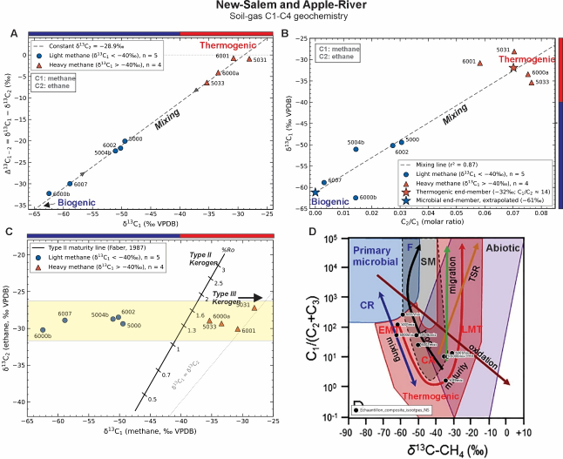
Figure 1. A) Δ¹³C₁₋₂ (δ¹³C₁ − δ¹³C₂) versus δ¹³C₁ for nine Nova Scotia soil gas samples (after Cesar et al., 2021). The dashed line shows the trend expected for a constant ethane composition (δ¹³C₂ = −28.9‰, sample median). B) δ¹³C₁ versus C₂/C₁ molar ratio, showing binary mixing between soil microbial methane and thermogenic gas. Because ethane is supplied only by the thermogenic end-member, mixing plots as a straight line (r² = 0.87). The thermogenic end-member (red star; δ¹³C₁ ≈ −32‰, C₁/C₂ ≈ 14) is the mean of the four heavy-methane samples. The microbial end-member (blue star; δ¹³C₁ ≈ −61‰) is extrapolated to C₂/C₁ = 0. C) Berner & Faber diagram: δ¹³C₂ (ethane) versus δ¹³C₁ (methane). The solid line is the type II (marine) kerogen maturity line after Faber (1987), graduated in vitrinite reflectance (%Ro). The dotted line marks δ¹³C₁ = δ¹³C₂. Ethane δ¹³C indicates a maturity of about 1.2–1.7 %Ro. Heavy-methane samples plot to the right of the type II line, which suggests a partly humic (type II–III) source. D) Revised Bernard diagram: C₁/(C₂ + C₃) versus δ¹³C₁, with genetic fields after Milkov & Etiope (2018), based on a global dataset of more than 20,000 natural gas samples. Fields: primary microbial gas (PM), secondary microbial gas (SM), early mature thermogenic gas (EMT), oil-associated thermogenic gas (OA), late mature thermogenic gas (LMT) and abiotic gas. Heavy-methane samples (δ¹³C₁ from −35 to −28‰; C₁/(C₂ + C₃) ≈ 10–13) fall within the thermogenic fields. Light-methane samples (δ¹³C₁ from −62 to −49‰; C₁/(C₂ + C₃) ≈ 25–260) plot where the microbial and early mature thermogenic fields overlap.
As anticipated in the October 6 and October 26, 2026, releases, the isotopes refine the molecular wet-gas classification. The Company’s gas interpretation is now based on ethane concentration and isotopes. The high-methane seeps, including the September peak reported on October 26, carry light methane with thermogenic ethane, identifying them as deep gas conduits overprinted by shallow methane rather than dry gas.
Three Additional Target Zones
The district now holds five defined target zones. Bennett Hill, where drilling returned up to 30% clean natural hydrogen and testing continues at DDH-26-05, and West-Advocate were defined by earlier work.
Zone 1: Northern Zone. A corridor approximately 6 km by 2 km in the northern New Salem sector, Cumberland Basin, and the first area on the project where all of the Company’s independent datasets are observed together:
- Helium. Strongly anomalous helium at the western and eastern ends of the zone, among the highest values of the 2026 survey.
- Ethane. An anomaly across the eastern part of the zone at 0.7–1.5 ppmv, up to ten times background and higher than concentrations measured on every surrounding survey line.
- Isotopes. The strongest thermogenic signature in the program: methane of −35 ‰ paired with ethane of −29 ‰, the coherent pairing expected of deep thermogenic gas, with the same heavy methane and thermogenic propane at the western end.
- Seismic. A 2026 line crosses the zone and will image the structure beneath it.
The zone sits away from the mapped faults at New Salem, indicating a separate structure as the probable conduit for both gas and helium. It is bounded: ethane on the lines immediately north and south returns to background, and the September lines between it and the New Salem Seep Corridor range from background to moderately anomalous. Once the seismic is processed, the Company expects to define this structure and advance the Northern Zone toward drill-ready status.
Zone 2: New Salem Seep Corridor Zone. A north-trending corridor approximately 3 km long, west of the Northern Zone:
- Ethane. Anomalous at 21 of 47 stations, the most continuous ethane anomaly in the survey, median 0.57 ppmv, five times background.
- Seep. 3,785 ppmv methane with 4.7 ppmv ethane, one of the two strongest emanations in the program, with 646 ppmv methane at the adjacent station.
- Isotopes. Thermogenic ethane at both sampled points, suggesting the corridor is fed by the same gas system as the Northern Zone.
Zone 3: Apple River Seep Zone. A focused seep zone sampled in two campaigns on lines 300 m apart:
- Repeat seeps. 4,007 ppmv methane in August and 1,287 ppmv in September, with methane concentrations of 1,787 and 480 ppmv at adjacent stations, the most consistently reproduced seep on the project.
- Helium. The station with the September methane peak also returned the highest helium concentration in the September program, at 5.573 ppmv. This represents the first direct coincidence of a gas seep and a helium anomaly at a single station.
- Isotopes. Thermogenic ethane with light methane: a deep gas conduit overprinted by shallow methane, not a dry-gas occurrence.
- Seismic. Two 2026 lines pass through the zone, and the longest September line, anomalous along its full 4 km with seven of the ten highest September helium values, lies in the same sector.
With clean natural hydrogen target zones at West-Advocate and Bennett Hill, the district holds five defined target zones, three of which are described in this release: three areas of confirmed gas emanation, two with coincident helium anomalies, all within the footprint of the seismic survey whose data are now being processed. Each dataset has added a zone or sharpened an existing one, and the project footprint continues to grow.
What seismic adds. Surface geochemistry shows where gas reaches surface; seismic shows the structure it comes from. The 63.7 line-kilometre 2D program completed by Echo Seismic Ltd. on October 14, 2026, is in processing at Earth Signal Processing Ltd. of Calgary. Integrating the two is what turns a surface zone into a defined target, and all three zones have been mapped so that the seismic sections can be read against them directly as they are delivered.
Seismic Completed in Québec and Ontario. The Company also confirms that seismic acquisition has been completed on its Québec and Ontario natural hydrogen projects. These programs apply the same approach used in Nova Scotia, imaging the fault and basement structures beneath the hydrogen-in-soil anomalies defined by the Company’s earlier surface geochemistry. The datasets are now advancing to processing, and results will be reported as they are received and interpreted.
References
Bernard, B.B., Brooks, J.M. and Sackett, W.M. (1976). Natural gas seepage in the Gulf of Mexico. Earth and Planetary Science Letters, 31, 48–54.
Berner, U. and Faber, E. (1988). Maturity related mixing model for methane, ethane and propane, based on carbon isotopes. Organic Geochemistry, 13, 67–72.
Berner, U. and Faber, E. (1996). Empirical carbon isotope/maturity relationships for gases from algal kerogens and terrigenous organic matter. Organic Geochemistry, 24, 947–955.
Cesar, J. et al. (2021). A novel isotopic approach to distinguish primary microbial and thermogenic gases in shallow subsurface environments. Applied Geochemistry.
Faber, E. (1987). Zur Isotopengeochemie gasförmiger Kohlenwasserstoffe. Erdöl Erdgas Kohle, 103, 210–218.
Milkov, A.V. and Etiope, G. (2018). Revised genetic diagrams for natural gases based on a global dataset of >20,000 samples. Organic Geochemistry, 125, 109–120.
Prinzhofer, A. and Huc, A.Y. (1995). Genetic and post-genetic molecular and isotopic fractionations in natural gases. Chemical Geology, 126, 281–290.
Technical Notes and Qualified Person
Carbon-isotope analyses were performed independently by InnoTech Alberta (Edmonton, Alberta). The scientific and technical information in this news release has been reviewed and approved by Professor Marc Richer-Laflèche, Ph.D., P.Geo., of the Institut national de la recherche scientifique (INRS), a Qualified Person as defined by National Instrument 43-101.
Market Advisory Services
The Company has engaged Red Cloud Financial Services Inc. (“Red Cloud”) to provide market advisory services. Red Cloud is an independent firm that provides capital markets advisory, investor relations and related services to issuers in the resource sector. Red Cloud and its principals may hold securities of the Company and may acquire or dispose of securities of the Company from time to time in accordance with applicable securities laws. The Company’s engagement of Red Cloud is subject to the policies of the Canadian Securities Exchange.
About Québec Innovative Materials Corp.
Québec Innovative Materials Corp. is a North American exploration company advancing district-scale clean natural hydrogen, helium and natural gas projects across Québec, Ontario, Nova Scotia and Minnesota. QIMC applies its proprietary R2G2 exploration framework, developed with INRS, to identify multi-gas systems and advance them toward pilot production without hydraulic fracturing or reservoir stimulation. In Cumberland County, Nova Scotia, the Company’s multi-gas pilot production pathway is built on more than 10,000 soil-gas samples and over 1,000 independent helium and C1–C4 analyses, 63.7 line-kilometres of 2D seismic, gravity, magnetic and radon-thoron surveys, and more than 3,500 m of core, with ongoing testing at DDH-26-05.
For further information:
John Karagiannidis, President & Chief Executive Officer
info@qimaterials.com
+1 514-726-7058
Cautionary Note Regarding Forward-Looking Statements
This news release contains forward-looking information within the meaning of applicable Canadian securities laws, including statements regarding planned analyses, the integration of geochemical and seismic data, possible additional seismic coverage and the Company’s exploration model. Such statements are subject to risks and uncertainties, including analytical limitations, uncertainty in geological interpretation and changes in program scope, timing or funding, and actual results may differ materially. Except as required by law, the Company undertakes no obligation to update forward-looking information.
Analytical Method. Carbon-isotope (δ13C) analyses were performed by InnoTech Alberta on gas remaining in the GeoFrontiers soil-gas sample containers. Samples were analyzed on a Thermo MAT 253 isotope-ratio mass spectrometer with a ConFlo IV interface, Trace GC Ultra and GC IsoLink. Gas was introduced through a Valco six-port valve and sample loop onto a GS-Q PLOT column (30 m, 0.32 mm ID); separated components were combusted at 1020 °C before analysis. Results are reported relative to the VPDB scale and calibrated with in-house methane standards, with a stated accuracy of ±0.2 per mil for methane δ13C. Methane was measured on one sample per survey-line group; remaining samples in each group were combined to obtain sufficient gas for ethane, propane, ethylene and propylene, which occur at sub-ppm concentrations near the limit of the method. The laboratory confirmed that CO2 did not interfere with the C2 measurements. Gas concentrations are from the GeoFrontiers C1–C4 dataset.
Cautionary Note Regarding Interpretation
Carbon-isotope and concentration results on soil gas indicate the likely origin of gases reaching surface; they do not establish the presence, size, composition or economic viability of any subsurface accumulation. Ethane and propane were measured at sub-ppm concentrations near the limit of the method, and combined samples represent several stations. References to a multi-gas system describe the Company’s exploration model, based on surface geochemistry, geophysics and limited drilling at Bennett Hill; hydrogen, helium and hydrocarbon gases differ in origin and have not been shown to occur together in any single accumulation. The New Salem–Apple River gas system has not been tested by drilling. No resource or reserve estimate has been prepared, and none is implied. The Company does not use and does not intend to use hydraulic fracturing or reservoir stimulation in Nova Scotia.