

Nova Scotia Project
R2G2 MODEL—FIRST FIELD VALIDATION & DISCOVERY RESULTS
Discovery Hole Depth (DDH-26-01)
Cobequid-Minas Fault Zone
INRS
Independent Scientific Validation
West-Advocate:
Where R2G2 Met the Drill
The West-Advocate hydrogen project in Nova Scotia represents the most significant milestone in QIMC's exploration history to date
— the first drill-tested, field-validated application of the Reactivated Rift and Graben Geostructure (R2G2) model. The model, co-developed by QIMC with Prof. Marc Richer-Lafleche of INRS Québec through years of geological work in the Témiscamingue region, predicted that the Cobequid–Minas Fault Zone would host an active natural hydrogen system. DDH-26-01 proved it correct.
- Cobequid–Minas Fault Zone hosts an active natural hydrogen system, proven correct by DDH-26-01.
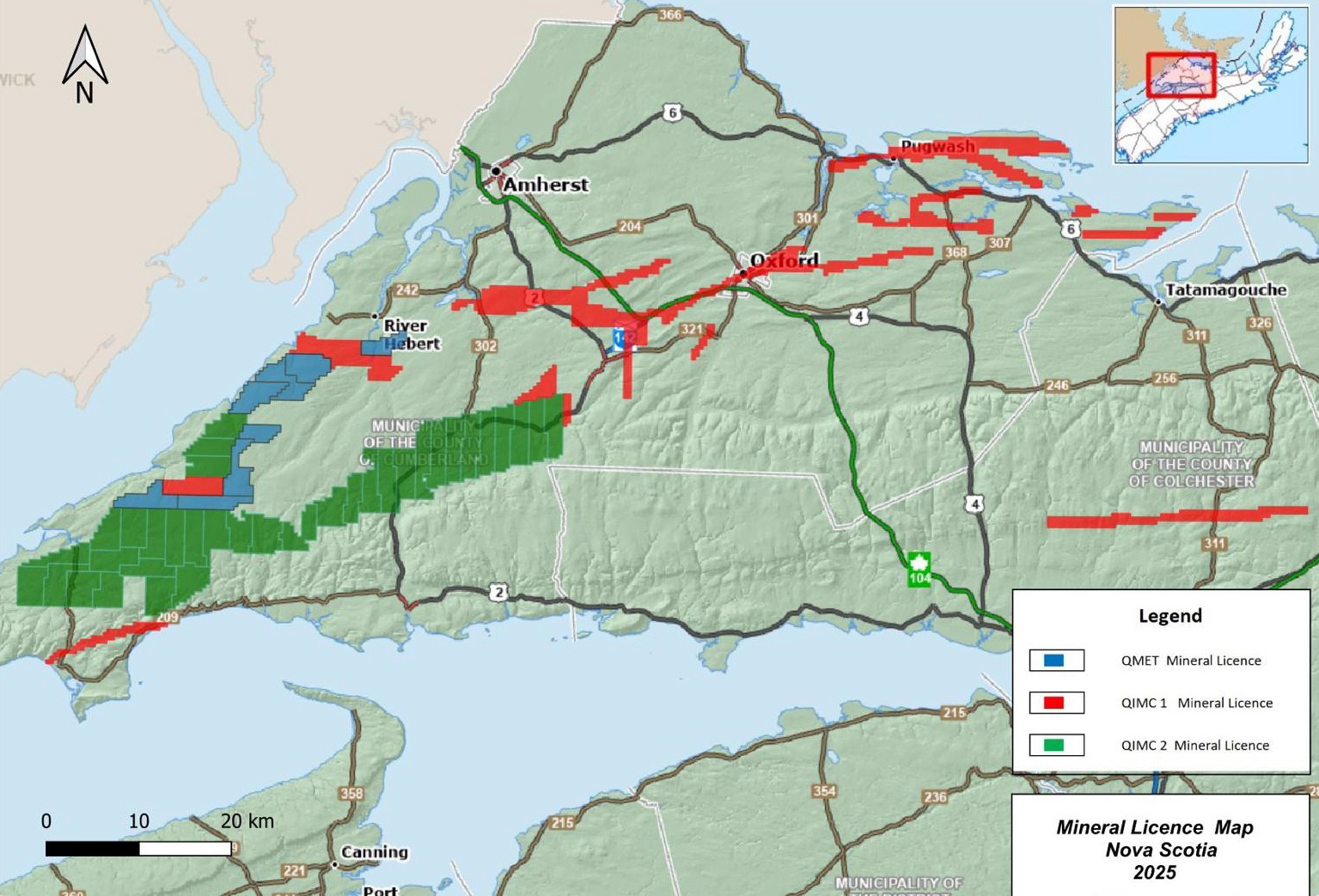
Click Image to Expand
What the R2G2 Model Predicted
At West-Advocate
- A large-scale, polyphase-reactivated structural corridor extending over 300 km along the Cobequid–Minas Fault Zone, with the geological character of an ancient reactivated rift system — the defining criterion of the R2G2 model
- Highly fractured rock volumes generating fracture porosity and permeability capable of supporting deep groundwater circulation and upward hydrogen migration from iron-rich or radiolytic crustal sources
- Multiple hydrogen trap geometries along the structural corridor, including structural, stratigraphic, and combined trap types at different scales
- An elevated geothermal gradient in the Cumberland region that could enhance hydrogen generation at shallower, more accessible crustal depths than comparable natural hydrogen systems globally
What DDH-26-01
Delivered
Visual Confirmation at Surface:

At 638 metres depth, gas bubbles were physically observed rising from the drill head — direct, real-time visual confirmation of free hydrogen escaping the formation under pressure
Instrument Exceedances:
GA5000 gas analyser detection limits exceeded on multiple separate depth intervals from 500–680 m, with independently confirmed concentrations of 2,150 ppmV in already-diluted wellhead water samples — representing the floor, not the ceiling, of in-situ formation concentrations
System Open at Depth:
Sustained, elevated hydrogen readings from 683 m to end of hole at 711 m confirmed the system does not fade with depth, leaving the true extent of the hydrogen column open for Hole 2 to test
Near-Zero Methane:
Methane recorded at approximately 0 ppm across virtually the entire sampled interval — ruling out competing interpretations and confirming a dedicated hydrogen system
Independent Scientific Validation
(INRS, March 2026)
Prof. Richer-Lafleche's post-drilling scientific review confirmed:
-
The R2G2 exploration model is scientifically validated by the Nova Scotia drilling data — the geological conditions the model predicted are present, active, and measurable at depth
-
Secondary faults along the Cobequid–Minas corridor are confirmed active conduits for natural hydrogen migration
-
Three distinct hydrogen trap types are identified within the structural corridor, confirming district-scale prospectivity beyond the immediate drill site
-
The elevated geothermal gradient of the Cumberland region enhances hydrogen generation at shallower depths than competing global programmes, reducing technical risk and capital requirements

The geological context is characterized by a large-scale, complex geostructure extending over more than 300 km, which has undergone a polyphase tectonic evolution” — exactly the conditions the R2G2 model was designed to identify
– Prof. Richer-Lafleche
Programme Status:
-
1
Hole 2 (QIMC-26-02)
Drilling underway, targeting structural zones to the northwest of DDH-26-01 where geophysical anomalies, elevated soil hydrogen, and high radon/thoron concentrations indicate additional migration pathways.
DDH-26-02 recorded a peak hydrogen concentration of 8,249 ppmV at 434 m depth, representing the highest single reading observed in the current drilling program and approximately 2.75 times the peak value recorded in the first hole, DDH-26-01. Hydrogen concentrations remained elevated at 500 m, where drilling was terminated due to seasonal ground conditions, indicating the system remains open at depth, and a surface soil-gas anomaly identified in prior work lies northwest of the bottom of the hole, beyond the depth reached by drilling to date. All hydrogen concentrations measured from borehole water samples are subject to dilution effects as previously disclosed in the Company's March 10 press release, including work by Prof. Marc Richer-Laflèche.
Hole DDH-26-02 demonstrates that hydrogen is not confined to a single interval, but occurs across multiple zones, with stronger and more consistent readings observed at depth. The persistence of elevated hydrogen at the end of drilling indicates that the system has not yet been fully defined. -
2
Five-hole 2026
Programme planned in total across the West-Advocate sector.
-
3
Ongoing INRS collaboration
For downhole geochemistry, isotopic analysis, and structural modelling.
From a geological model to field-proven results — the R2G2 framework continues to demonstrate its power as a repeatable, science-first exploration tool.”
John Karagiannidis — President & CEO, Québec Innovative Materials Corp.